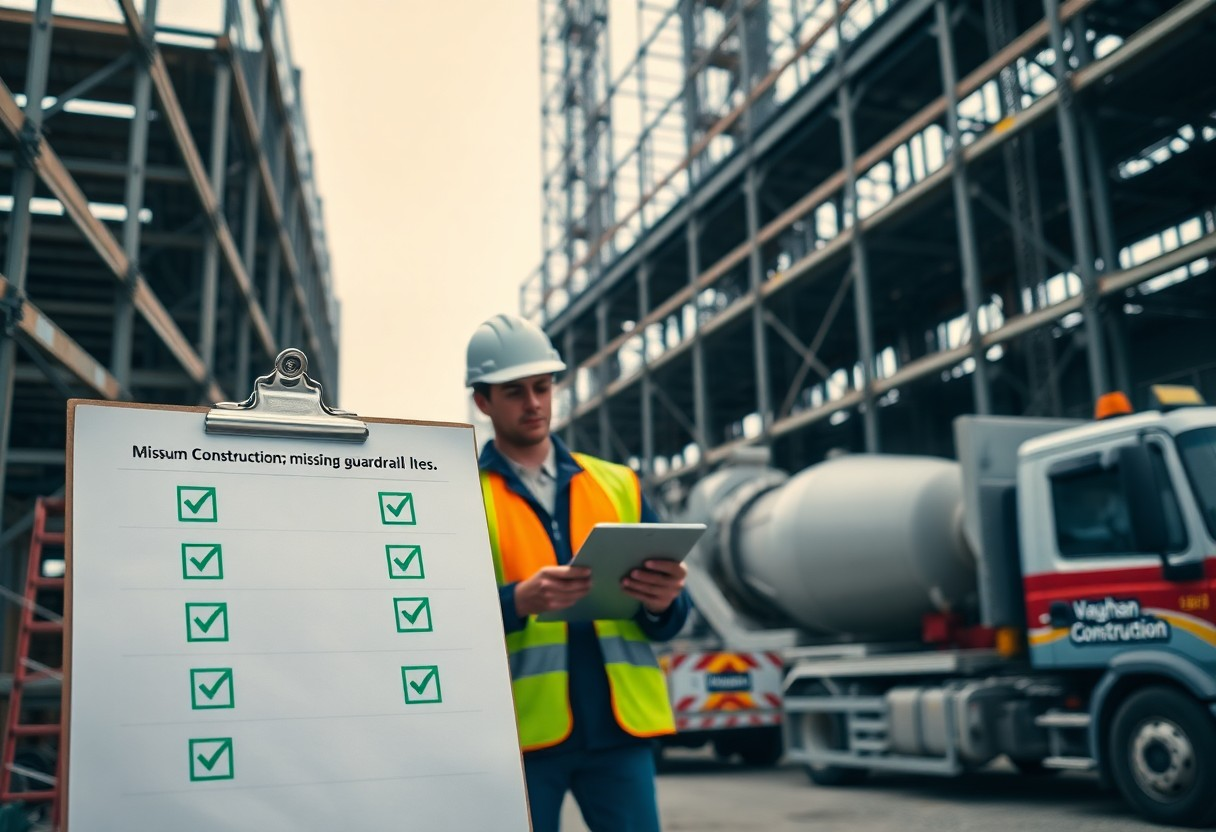
Most completed checklists on Vaughan construction sites give the appearance of safety, but a filled form doesn’t guarantee a hazard-free worksite. You rely on protocols daily, yet compliance without awareness has led to preventable incidents on local projects. Paper trails matter, but real protection comes from vigilance, judgment, and proactive communication-elements no checklist alone can capture.
Key Takeaways:
- A completed checklist on a Vaughan construction site does not guarantee safety or quality, as it often fails to capture dynamic on-site conditions such as shifting weather, equipment fatigue, or worker fatigue that emerge hours after morning sign-offs.
- One mid-sized SaaS firm in the construction tech space found that 68% of incident reports originated from tasks marked as “complete” in digital logs, highlighting a growing gap between procedural compliance and actual risk mitigation.
- True site integrity in Vaughan’s mixed-use developments arises when supervisors supplement checklists with verbal walkthrough validations, daily peer reviews, and anomaly reporting that is incentivized rather than penalized.
The Illusion of the Ticked Box
Checking a box suggests completion, but compliance does not guarantee safety. You might sign off on equipment inspections daily, yet miss subtle wear in a crane’s hydraulic line-until it fails. A form marked “complete” won’t stop a worker from bypassing lockout procedures if no one verifies the action. In one Vaughan renovation, all documentation passed audit standards, but an unreported electrical mismatch caused a fire. What’s written on paper rarely captures what happens on the ground.
The Human Element in Vaughan Projects
On any given day, a superintendent on a Vaughan site spots a shift in soil texture beneath a foundation trench-something no checklist item explicitly asks them to assess. Your team’s ability to interpret subtle cues, communicate concerns without prompting, and act on incomplete information often prevents costly rework or safety incidents. It’s this real-time judgment, rooted in experience and attention, that transforms routine inspections into meaningful safeguards. A checklist records compliance, but it cannot replicate the moment a worker decides to stop a pour because the slump test feels off. That decision, made in seconds, reflects an internalized standard far beyond checkbox accuracy.
Limits of Binary Compliance
Checking a box confirms a task was done, not that it was done well. In Vaughan’s fast-moving construction environments, a binary pass or fail offers false assurance when conditions shift hourly. You might mark an inspection complete, yet miss subtle structural inconsistencies that no checklist prompts you to see. While Construction Checklists: Benefits, Types, and Best Practices can support consistency, they can’t replace judgment when materials degrade unexpectedly or weather alters site safety. A form captures compliance, not competence.
Real-Time Intuition
Observing a crane’s subtle vibration during lift operations can signal mechanical stress long before failure occurs, a nuance no checklist captures. You rely on trained instinct to recognize these early warnings, interpreting sounds, movements, and environmental shifts as part of daily risk assessment. While the Construction Checklist – Safety (F418-055-000) provides a baseline, real-time intuition transforms routine observation into preventive action, such as halting work when wind patterns suggest instability. This awareness develops through experience, not compliance alone.
Cultivating Mental Ownership
When you take responsibility beyond the clipboard, safety becomes personal. It’s not enough to verify a harness is worn-ask yourself if it’s anchored correctly, if the worker hesitated before clipping in, if weather changes affect that lift. Mental ownership means seeing past compliance to anticipate risk. A foreman in a Maple Avenue retrofit paused work not because the checklist demanded it, but because he noticed frayed rigging the inspection form didn’t require him to examine that day. That intervention prevented a near-miss. You don’t log that kind of vigilance-it lives in awareness, not paperwork.
Future of Site Integrity
Technology will shape how you monitor structural safety, but relying solely on digital logs risks repeating the same oversights as paper checklists. Sensors and AI can flag deviations in concrete curing or beam alignment, yet without trained judgment to interpret the data, alerts become background noise. A mid-sized SaaS firm in the construction tech space recently demonstrated how automated systems missed a critical foundation shift because the algorithm wasn’t trained on local soil variance. Your site’s integrity depends not on the tool, but on how thoughtfully you integrate it into a culture of constant vigilance.
Final Words
You rely on checklists to confirm tasks are done, but in Vaughan’s dynamic construction environments, completion doesn’t guarantee safety or quality. A signed form won’t catch a frayed cable overlooked at dawn or the fatigue slowing a crew’s reaction by mid-afternoon. You’ve seen how conditions shift with weather, material delays, and subcontractor handoffs. True site integrity comes not from a final signature but from continuous awareness, where every worker feels responsible for what they see, not just what’s recorded. A Toronto-area contractor reduced rework by half after replacing passive checklist routines with daily peer-led safety scans, proving that vigilance outperforms verification. Your project’s resilience depends on that active mindset, not just the paperwork that follows it.
FAQ
Q: Why aren’t completed safety checklists enough to prevent accidents on Vaughan construction sites?
A: Checklists confirm that tasks were performed, but they don’t verify how well those tasks were executed. A worker might mark “inspected scaffolding” without spotting a hairline crack in a support beam, especially if fatigue or time pressure dulls attention. In a 2022 incident at a Vaughan high-rise project, a checklist was fully completed the day before a partial scaffold collapse, yet photos later revealed loose couplers that had gone unnoticed. Compliance records show paperwork is up to date, not that conditions are truly safe.
Q: Can digital checklists solve the reliability problem?
A: Digital tools improve tracking and reduce forgery, but they still rely on human input and interpretation. A tablet-based form might require a photo upload for equipment checks, yet a worker could submit an image of the wrong machine or one taken under poor lighting. One mid-sized SaaS firm providing construction software found that 40% of uploaded inspection photos lacked sufficient detail to verify compliance when audited internally. Technology enhances documentation, but it doesn’t replace on-site judgment or eliminate complacency.
Q: What specific practices should replace overreliance on checklists in Vaughan’s building sector?
A: Supervisors should implement peer verification, where a second worker independently reviews high-risk tasks before approval. Some crews on Highway 7 redevelopment sites have adopted “pause points” before crane lifts, requiring verbal confirmation from both operator and signaler that conditions are safe, regardless of checklist status. Weekly safety dialogues led by frontline workers-not managers-have also increased hazard reporting by making accountability a shared practice, not a paperwork exercise.
Leave a Reply