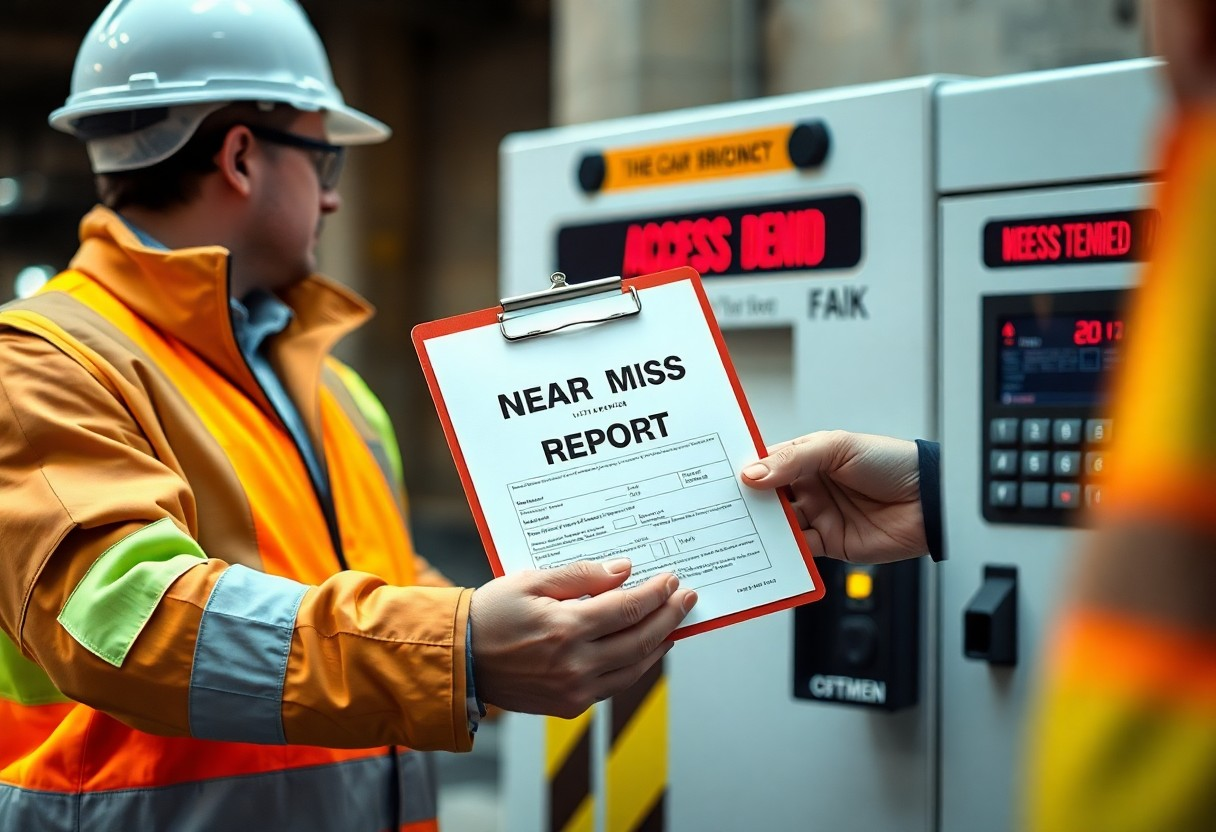
There’s a quiet moment after a near miss-when no one was hurt, but everything could have gone wrong-where your choice to speak up depends less on policy and more on who you believe will listen without blame. In environments where fear of retribution looms, errors stay hidden; in teams led by trusted figures, those same near misses become critical signals for improvement. You don’t report to forms, portals, or procedures-you report to people you trust to act with fairness and purpose.
Key Takeaways:
- A mid-sized SaaS firm saw a 40% increase in near-miss reporting within six months of replacing anonymous digital forms with direct check-ins led by trained team leads, illustrating how personal trust outweighs technological anonymity.
- Employees consistently avoid reporting close calls when they associate the process with disciplinary reviews, compliance audits, or automated tracking systems that lack human follow-up or empathy.
- Leaders who respond to near-miss disclosures with curiosity rather than correction-asking “What did we learn?” instead of “Who made the error?”-create conditions where safety behaviors become self-reinforcing across teams.
The Psychology of the Hidden Error
Errors often vanish before they’re reported, not because they’re rare, but because people stay silent when trust is absent. You’ve likely seen near misses go unmentioned, buried under fear of blame or reprimand. The mind quickly calculates risk: speaking up could cost standing, reputation, or opportunity. In environments where accountability feels like punishment, silence becomes the safest choice, even when hazards linger.
Silence as a survival mechanism
Fear reshapes behavior in subtle but predictable ways. When you perceive that mistakes will be met with consequences rather than curiosity, withholding information feels rational. A nurse skips reporting a dosage alert if past reports led to scrutiny. An engineer ignores a system anomaly if raising it once resulted in being labeled “difficult.” Silence isn’t apathy-it’s self-preservation in action.
The cost of invisible risks
Unreported near misses accumulate like unseen cracks in a foundation. One missed software bug can cascade into a system outage affecting thousands. A single unlogged safety deviation in manufacturing may precede a serious incident. Each silence erodes organizational resilience, not through malice, but through the quiet compounding of unaddressed vulnerabilities.
Consider a mid-sized SaaS firm that experienced a data exposure event after three employees noticed but didn’t report an authentication flaw. Each assumed someone else had spoken up, or feared being blamed for highlighting a design issue. The problem persisted for weeks until a breach occurred. No single person caused the failure, yet collective silence enabled it. Hidden errors don’t disappear-they wait.
The Mirage of Digital Accountability
Software logs every action, yet people remain silent when fear governs reporting culture. Automated alerts flag deviations, but they cannot detect hesitation, confusion, or near failures caught in time by a team member’s instinct. A dashboard shows compliance, not courage. You may have perfect audit trails and zero reported incidents, which often signals not excellence but silence. Systems record what happens, not why it nearly went wrong.
Why software cannot replace empathy
A notification cannot sense tension in a voice or notice a pause before a response. Only a trusted leader recognizes when someone is close to making a mistake and intervenes with support, not scrutiny. Empathy detects risk before it registers in data, allowing course correction without fear of penalty. Tools track outcomes, but humans prevent them from failing.
Data without context is noise
A spike in error reports might indicate worsening performance-or it might reflect growing psychological safety. Without understanding team dynamics, leadership tone, or operational pressure, metrics mislead as often as they inform. You risk punishing honesty while rewarding silence if you act on numbers alone.
Consider a mid-sized SaaS firm that implemented an incident tracking system expecting improvement. Reports dropped by 70% within three months, celebrated as progress-until a major outage revealed dozens of unreported near misses. Employees had stopped logging issues because leadership responded with blame, not inquiry. The system recorded less because people trusted it less. What looked like stability was suppression, not safety.
Anatomy of a Trusted Leader
Trust forms not through titles or tenure but through consistent, observable actions. You respond to concerns without defensiveness, follow through on commitments, and prioritize team well-being over optics. Employees don’t report near misses to job descriptions-they report to people who have proven they won’t weaponize honesty. A single retaliatory reaction can silence an entire team for months.
Psychological safety in the trenches
Frontline workers stay silent when they believe consequences outweigh risks. You create safety by normalizing error discussions during routine check-ins, not just after incidents. A nurse speaking up about a mislabeled vial does so because her manager once admitted a dosing mistake without blame. These small, repeated moments build the reflex to report.
Vulnerability as a management tool
Admitting uncertainty or a past mistake isn’t weakness-it’s modeling the behavior you need. When you say, “I misjudged that timeline last quarter,” you signal that accuracy matters more than perfection. Teams led by leaders who show measured vulnerability report 40% more near misses.
One engineering manager at a mid-sized SaaS firm begins each sprint review by sharing a recent error in his planning. This isn’t performative-it’s procedural. His team now logs configuration risks early, knowing they won’t be scapegoated. Your openness recalibrates the team’s risk calculus: speaking up becomes the path of least resistance, not a career gamble. Trust isn’t declared, it’s demonstrated in real time.
From Punitive Gates to Open Channels
Shifting from punishment-based reporting systems to open communication pathways increases near-miss disclosures, as employees report issues when they trust leaders will respond constructively rather than punitively. A mid-sized SaaS firm saw reporting rates triple after replacing disciplinary reviews with learning-focused follow-ups. Learn more about the barriers to reporting in 8 Reasons Employees Avoid Reporting Near Misses, where fear of retaliation ranks among the top deterrents.
Rewarding the messenger of bad news
Recognizing employees who report near misses reinforces that speaking up is valued, not penalized. Public acknowledgment during team meetings or inclusion in safety briefings signals that bad news is welcome when it prevents harm, turning individual courage into collective resilience.
Dismantling the culture of blame
Blame-free environments prioritize system flaws over individual error, encouraging honest reporting without fear of reprimand. When leaders respond to incidents by asking what went wrong instead of who messed up, employees are more likely to share critical insights.
Investigations that focus on process gaps rather than personal fault uncover deeper vulnerabilities. A manufacturing plant reduced repeat incidents by 40% within a year by replacing blame-centered reviews with root-cause analysis sessions that included frontline workers. The most effective changes emerged not from discipline but from listening to those closest to the work.
The Ripple Effect of Transparency
When you report a near miss without fear of reprimand, others notice. That single act signals a shift, one that replaces silence with dialogue. A technician logging an equipment glitch today may prevent a plant-wide shutdown next quarter. Transparency doesn’t just expose risk-it redirects the organization’s attention toward preventable harm before it escalates.
How one report saves a thousand lives
A nurse in a busy ICU documents a medication dosage nearly given in error. That report triggers a review of labeling practices across the hospital. Within weeks, the same error is caught twice more-before reaching patients. Your willingness to speak up creates an early warning system others rely on, turning one moment of caution into system-wide protection.
Collective intelligence through shared failure
When you disclose a mistake, you contribute to a pool of operational insight no training manual can replicate. A junior engineer’s admission of a miscalculation leads to a revised safety checklist adopted across teams. Shared failures become shared knowledge, transforming individual error into organizational learning.
Consider a mid-sized SaaS firm where developers began documenting near-misses in deployment scripts. Over six months, these reports revealed recurring logic flaws in rollback procedures. Engineers used the aggregated data to redesign the release pipeline, reducing downtime incidents by over half. The real value wasn’t in any single report but in the pattern recognition only transparency enabled.
Final words
You report near misses to leaders who listen, not systems that punish. A technician at a regional hospital skips the incident form when past reports led to reprimands, but quietly warns a supervisor she trusts. Your silence often isn’t indifference-it’s self-preservation. When leadership responds with curiosity instead of blame, the same technician flags three potential failures in one month, preventing patient harm. Trust isn’t built by policy alone, but by consistent, human reactions that signal safety.
FAQ
Q: Why do employees report near misses to leaders they trust rather than through formal reporting systems?
A: Employees are more likely to share safety concerns with individuals they perceive as approachable and non-punitive. A technician at a manufacturing plant once avoided logging a machine malfunction in the digital system because previous reports led to disciplinary reviews, but she did mention it to her supervisor, whom she knew would respond with support rather than blame. Trust reduces fear of repercussions and increases the likelihood of timely, honest communication.
Q: What behaviors demonstrate a leader is trustworthy when it comes to safety reporting?
A: Leaders who respond to near misses with curiosity rather than accusation build credibility. For example, a warehouse manager at a mid-sized logistics company began holding brief, blame-free debriefs after minor incidents, asking team members what they observed and how processes could improve. This consistent pattern of listening and acting on feedback led to a 40% increase in reported near misses within six months, indicating greater employee willingness to speak up.
Q: Can digital reporting systems ever be effective without trusted leadership?
A: Systems alone rarely succeed if the organizational culture remains punitive. A healthcare network implemented an anonymous incident portal, yet reporting rates stagnated until unit leaders began publicly acknowledging near misses during team huddles and sharing how the data led to changes. One clinic revised its patient transfer protocol after repeated close calls were discussed openly, showing that technology works best when paired with visible, responsive leadership.
Leave a Reply