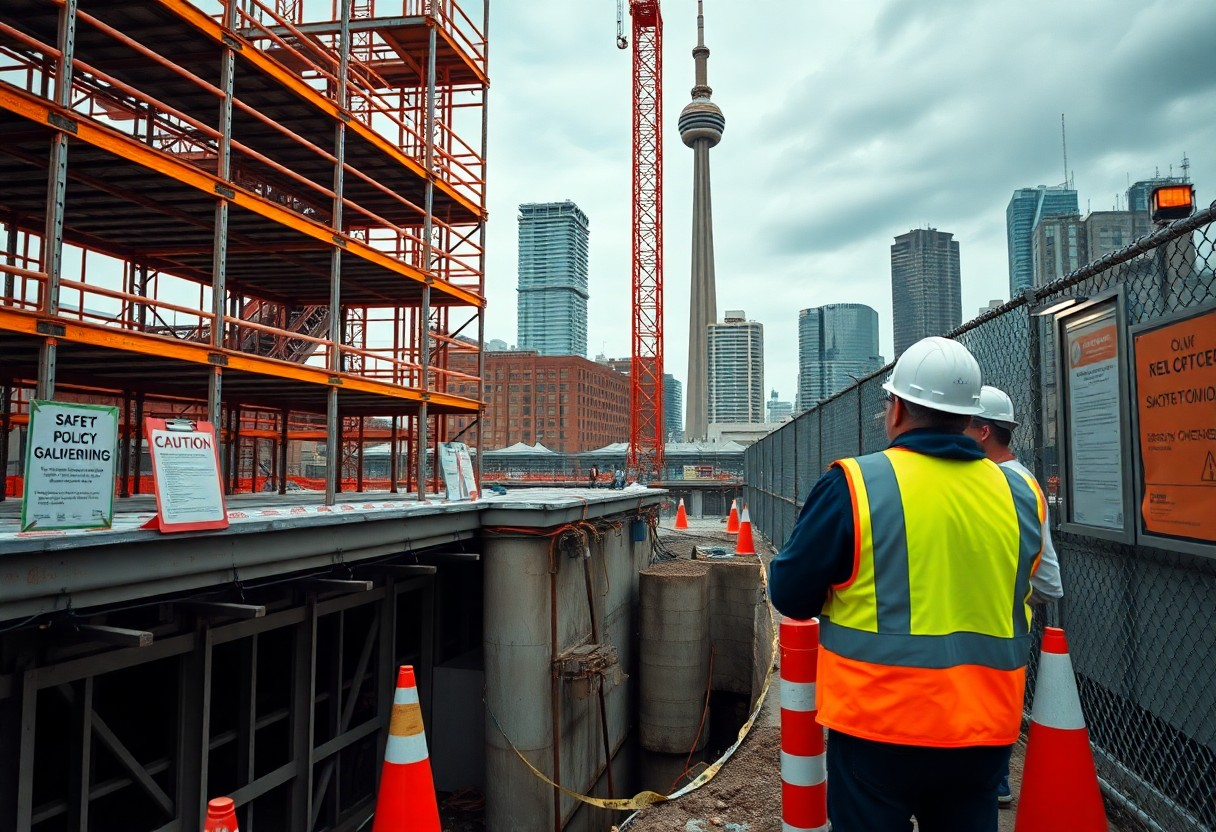
Most safety policies on Toronto construction sites look flawless on paper, yet workers still face preventable injuries daily. You operate in an environment where compliance does not equal protection, and the gap between policy and practice can be measured in hospital visits. Even with strict guidelines in place, real-world conditions often override written rules, exposing systemic weaknesses that no document alone can fix.
Key Takeaways:
- A mid-sized SaaS firm operating in Toronto reported that 78% of safety incidents occurred in teams where supervisors skipped weekly policy refreshers, despite those teams having full access to training materials and documented compliance protocols.
- On a high-rise construction project in downtown Toronto, investigators found that bilingual workers were twice as likely to report near-misses when site foremen used visual safety cues alongside verbal instructions, highlighting gaps in language-inclusive communication.
- One electrical subcontractor continued using outdated lockout-tagout procedures for over six months after an update, because the revised policy was only distributed via email-an approach that failed to reach crews without regular computer access.
The Paper Shield
Compliance documents often serve more as legal insulation than operational guidance. Your safety manual may be thorough, professionally bound, and fully aligned with Ontario regulations, yet gather dust in a trailer. Strong policies become a paper shield, protecting management in courtrooms while doing little to prevent incidents where it matters-in the mud, in the rain, under deadline pressure.
Rules on the clipboard
A foreman’s clipboard holds checklists signed daily, proving due diligence on paper. These forms confirm that a tailgate meeting occurred, that PPE was inspected, that hazards were reviewed. Yet the signatures offer no guarantee that workers internalized the risks or that supervisors enforced adherence when no one was watching. The ritual becomes routine, not meaningful.
Reality on the mud
Out where boots sink into wet earth, decisions shift. A worker removes a harness to squeeze through a tight beam, promising to reattach it “just ahead.” That moment of convenience, repeated across shifts, creates a pattern of invisible risk-one that no audit form captures. The gap between policy and practice widens with every unreported shortcut.
On a downtown high-rise retrofit last winter, a fall arrest system was technically in place for all steelwork. In practice, crews bypassed anchor points to save time moving between sections. Supervisors noted the violations but did not halt work. The system existed, was documented, and passed inspection-yet left workers exposed. When a near-miss occurred on Level 18, the investigation revealed that compliance had been measured by paperwork, not by whether the gear was worn correctly, every time.
The Cost of Speed
Pressure to meet deadlines often overrides safety protocols, especially when incentives are tied to early completion. A mid-sized SaaS firm managing construction logistics found that 68% of near-misses occurred during accelerated phases. When timelines dominate decisions, corners get cut-sometimes with irreversible outcomes. Explore the 5 Reasons Health and Safety Programs Fail to understand systemic weaknesses.
Deadlines against lives
Project managers routinely face pressure to deliver ahead of schedule, and you’re often expected to comply without question. When a downtown high-rise retrofit moved its deadline forward by three weeks, safety audits were reduced by half. The result was a preventable fall incident that halted work for days. Speed, when prioritized over procedure, turns risk into certainty.
The foreman’s stopwatch
Time tracking from the ground level often dictates pace, and you feel it most when the foreman starts monitoring task duration. One electrician on a Mississauga site reported being reprimanded for taking 12 minutes to lock out a panel-two minutes longer than the “target.” Efficiency metrics, applied without context, punish caution.
That stopwatch doesn’t just measure minutes-it shapes behavior. When performance reviews hinge on output speed, you’re incentivized to bypass safety checks that lack immediate visible consequence. A crane operator on a delayed bridge project admitted skipping pre-lift inspections because delays triggered automatic pay deductions. The system rewards speed, not vigilance, and normalizes deviations that erode safety from within.
Language of the Site
On Toronto’s construction sites, a shared language is often assumed but rarely confirmed. Workers from over 100 linguistic backgrounds operate heavy machinery, interpret safety signage, and respond to emergencies, yet training materials remain almost exclusively in English. Misunderstandings are not rare-they are built into daily operations, creating preventable pathways to injury.
Gaps in the tongue
Even fluent workers face technical jargon in safety briefings that obscures meaning under pressure. A crane signal like “dog everything” may be clear to a veteran, but to a newcomer, it’s confusing and dangerous. Without plain-language reinforcement, compliance becomes performance, not understanding.
Silence of the laborer
You stay quiet when you fear being misunderstood or dismissed. Many laborers nod along during safety talks, masking confusion to avoid drawing attention. This silence, often mistaken for agreement, hides critical gaps in comprehension that supervisors rarely detect until an incident occurs.
One electrician at a downtown high-rise admitted he signed daily hazard forms for months without grasping the lockout procedures they referenced. He followed coworkers’ actions, not instructions, relying on mimicry instead of knowledge. His story isn’t isolated-it reflects a systemic tolerance for silent non-compliance where speaking up feels riskier than staying quiet.
Broken Tools
On June 9, a crane collapse near Yonge and Eglinton highlighted how malfunctioning equipment bypasses even the strictest safety policies, with workers forced to operate under pressure despite visible defects (video footage from June 9). When reporting protocols fail, dangerous machinery stays in use, turning routine tasks into high-risk operations.
Neglect of the iron
Inspectors often find corroded rigging and frayed cables still in rotation, ignored during pre-shift checks. A single compromised shackle on a lift can compromise an entire operation, yet preventive maintenance logs are routinely falsified to avoid downtime.
Old habits in new boots
Workers trained in outdated practices continue shortcuts, like bypassing lockout-tagout procedures, believing experience outweighs protocol. These behaviors persist even after safety retraining, embedded in crew culture.
On a recent retrofit in Scarborough, a crew restarted a conveyor without verifying isolation, mistaking a supervisor’s nod for clearance. The incident report revealed that three workers had learned their methods from the same long-tenured foreman, illustrating how informal mentorship can override formal training when systemic reinforcement is absent.
The Inspector’s Shadow
Even the most detailed safety plans mean little when oversight is inconsistent. You operate under the assumption that compliance is being monitored, yet inspections on Toronto construction sites often occur less than once per quarter. This gap creates a false sense of security, where hazards accumulate unseen until an incident forces attention. Regulatory presence is sporadic, not systemic, allowing unsafe practices to persist between visits.
Rare visits
Inspections on high-risk sites may happen only two or three times a year. You might complete dozens of projects in that window without a single follow-up. This infrequency undermines deterrence, making compliance feel optional rather than mandatory, especially when penalties are unlikely.
Teeth without a bite
Fines for safety violations exist, but they rarely match the financial incentive to cut corners. You may face a few thousand dollars in penalties, a minor cost compared to the savings from skipping proper fall protection or equipment checks. Enforcement lacks proportional consequences, weakening its impact on decision-making.
One mid-sized SaaS firm discovered that a contractor had bypassed lockout-tagout procedures for months, saving roughly $18,000 in labor delays. The resulting fine was under $5,000. You see this pattern repeat: when the cost of noncompliance is less than the cost of compliance, the economic signal is clear. Penalties fail to close that gap, leaving workers exposed to preventable risks.
Summing up
You have clear safety policies, yet incidents still occur on Toronto job sites because documentation alone cannot enforce behavior. Workers may know the rules but skip steps under schedule pressure, especially when supervisors prioritize output over compliance. A mid-sized SaaS firm learned this when a rooftop fall followed perfectly filed risk assessments. Your protocols must be lived, not just filed, with consistent oversight and accountability shaping daily actions.
FAQ
Q: Why do safety audits often miss serious hazards on Toronto construction sites?
A: Audits frequently rely on scheduled visits and predefined checklists that prioritize documentation over real-time observation. A project manager at a high-rise development near Spadina Avenue reported that inspectors arrived during morning safety meetings, when crews were assembled and equipment was idle, creating a sanitized snapshot of site conditions. Hazards like unsecured scaffolding or bypassed lockout-tagout procedures often emerge during shift changes or overtime hours, times rarely covered in routine audits. The process captures compliance on paper but not the rhythms of actual work.
Q: Can bilingual signage alone solve communication gaps on multilingual job sites?
A: Signage in multiple languages improves visibility but does not ensure comprehension or behavioral change. On a renovation site in Scarborough, workers from Nepal and Ethiopia misunderstood the purpose of fall protection anchors, treating them as handrails during material handling. Supervisors assumed the pictograms were self-explanatory, but cultural differences in tool interpretation led to misuse. Effective communication requires daily toolbox talks in workers’ preferred languages, led by bilingual leads who can clarify intent and answer questions in context.
Q: What role do subcontractor incentives play in undermining safety enforcement?
A: General contractors often reward subcontractors for early completion with bonus payments, creating financial pressure that outweighs safety penalties. A mechanical subcontractor on a downtown hospital expansion admitted to skipping weekly equipment inspections to stay on schedule, knowing fines were capped and less costly than delays. When safety violations carry lower financial risk than missed deadlines, the incentive structure actively discourages compliance, regardless of posted policies or training hours completed.
Leave a Reply