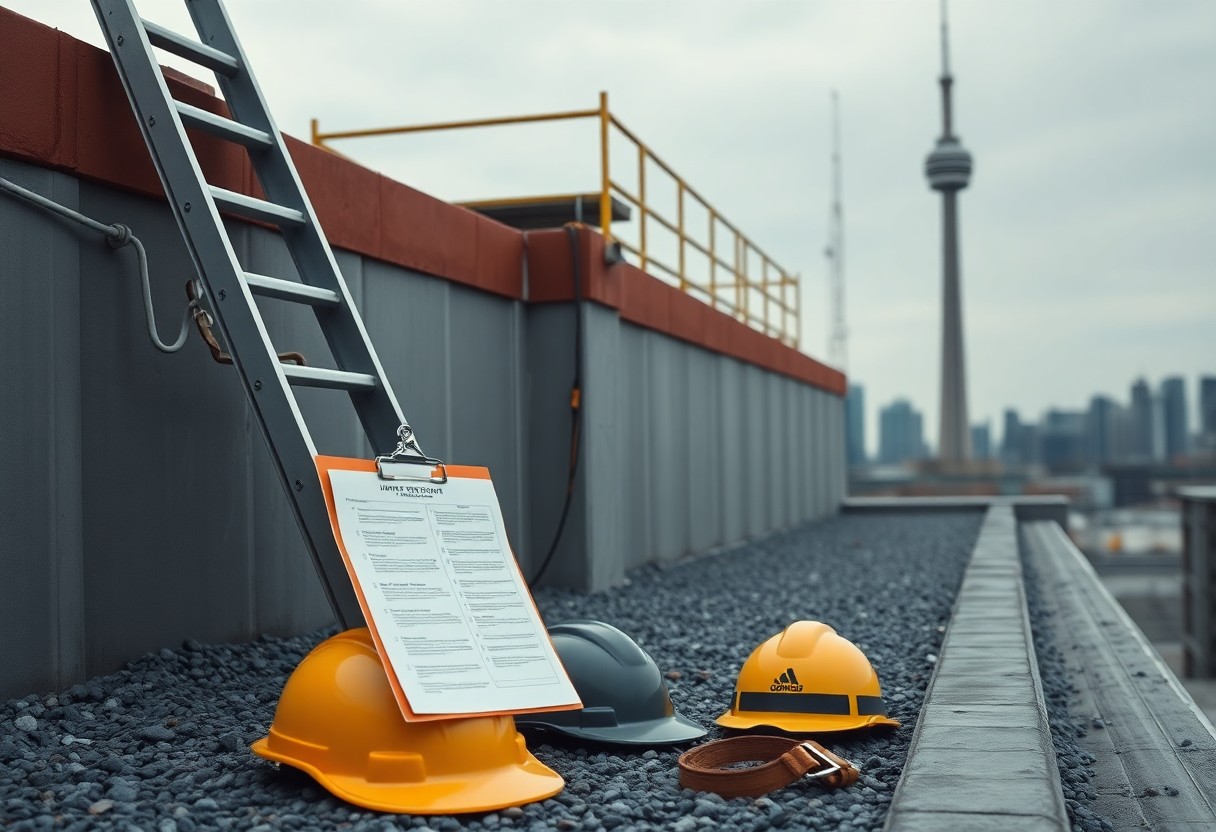
Over 20% of workplace fatalities in Ontario involve falls, and you may not realize your current training fails to meet the province’s mandatory working-at-heights requirements. Many employers assume basic orientation is enough, but only Ministry-approved training with hands-on components satisfies the law. When inspectors arrive, the gap between compliance and assumption becomes dangerously clear.
Key Takeaways:
- A mid-sized SaaS firm in Waterloo discovered during a routine inspection that two of its maintenance staff had been accessing rooftop HVAC units without fall protection, exposing the company to immediate stop-work orders under Ontario’s Occupational Health and Safety Act.
- Training records at a manufacturing plant near Hamilton showed employees had completed fall protection certification five years prior, but no refresher sessions had been scheduled, violating the province’s requirement for re-evaluation every three years.
- Inspections at a construction site in Ottawa revealed that shock-absorbing lanyards had been in continuous use for over seven years, well beyond the typical five-year service life recommended by most manufacturers under normal conditions.
The Deceptive Calm of the Filing Cabinet
Peace of mind often settles where documentation appears complete, yet a neatly labeled binder of training records can mask dangerous gaps. Your team may have signed the sheet, but signed sheets don’t stop falls. Compliance isn’t measured in ink-it’s proven in practice, under real conditions, every single time.
Shadows Cast by Surface Compliance
A clean audit trail means little if the reality on the roof tells a different story. You might pass a desk review while failing the test of gravity. Inspectors look beyond paper; they watch how workers interact with anchors, lanyards, and edges when no one is checking the clipboard.
The Illusion of the Valid Certificate
A certificate dated within the last three years gives the appearance of compliance, but dates alone don’t confirm competence. You may believe your crew is certified, only to discover they’ve never practiced a rescue on the exact system installed on your site.
Training validity hinges on relevance, not just recency. That certificate might reflect a generic classroom session using outdated equipment, not the specific fall arrest system on your facility’s roof. Workers can be fully certified and still unprepared for the anchor points, harness types, or rescue procedures required in your environment, leaving you exposed the moment someone steps near the edge.
The Ticking Clock of the Three Year Mandate
Every three years, your fall protection training certification expires, resetting the compliance clock. Working without current certification invalidates your team’s authorization to perform at-height tasks, exposing your company to immediate regulatory risk. This cycle doesn’t pause for staffing changes or project delays.
Tracking the Silent Expiry of Credentials
Training records often sit unmonitored until an audit or incident occurs. A single expired certificate can trigger a worksite shutdown, especially during surprise inspections. Without automated alerts or centralized tracking, these expiries become invisible liabilities.
Administrative Lapses in High Places
Manual tracking systems rely on memory and spreadsheets, creating gaps even in well-managed firms. One missed renewal in a crew of ten can halt operations across multiple sites, disrupting timelines and inviting fines.
Human error compounds when supervisors juggle multiple certifications across rotating shifts. A mid-sized SaaS firm managing its own compliance once lost two weeks of field operations after discovering 40% of its technicians had lapsed training. Relying on paper logs or decentralized files increases the likelihood of oversight, particularly during high turnover periods. Provincial inspectors do not accept “we thought it was current” as a defense.
The Subtle Decay of Fall Protection Gear
Every time you clip into a harness or anchor a lanyard, you assume the equipment will hold. Yet microscopic wear, UV exposure, and chemical residues silently compromise fibres, reducing strength over time. A single frayed strand may not fail immediately, but under load, it can unravel catastrophically. What looks intact often isn’t.
Deterioration Beneath the Webbing
Hidden inside webbing folds, moisture and grit accumulate, accelerating internal abrasion. A harness used weekly on a rooftop HVAC unit may show no surface damage, yet internal fibres can weaken by half within two years. You can’t see the damage, but the load test will.
The Neglected Ritual of Daily Inspection
Skipping a pre-use check takes seconds, but the risk compounds with every climb. A frayed carabiner gate or stiff retractor might go unnoticed until deployment. One worker in British Columbia survived a 12-metre fall only because he’d inspected his lanyard that morning and caught a torn stitching.
Most manufacturers require users to run hands over every inch of webbing, checking for stiffness, thinning, or melted fibres near edges. You’re not just looking-you’re feeling for inconsistencies that signal hidden compromise. A harness exposed to welding slag, even indirectly, can suffer heat degradation that isn’t visible under office lighting. Your daily inspection isn’t a formality; it’s the last line of defence before trust becomes a liability.
The Chasm Between Lecture and Ledge
Training that stops at theory creates a dangerous gap between classroom confidence and real-world risk, leaving workers unprepared when footing slips and harnesses engage. Compliance without competence is a liability-especially when lives depend on split-second decisions. Learn more about The One Thing Missing in Working-at-Heights Safety.
Theoretical Knowledge vs Vertical Reality
Understanding fall protection principles on paper does not prepare you for wind gusts on a narrow beam or the weight shift when your foot misses a rung. Real heights demand real experience, not just diagrams and checklists reviewed in a ground-level meeting room.
Site Specific Hazards Left Unaddressed
Generic training often overlooks the unique dangers of your worksite, such as uneven terrain, overhead lines, or dynamic loads near edges. Failure to identify these in advance increases the likelihood of misjudged movements and delayed reactions.
Every rooftop, scaffold configuration, and industrial setting introduces variables that off-the-shelf training rarely covers. A mid-sized SaaS firm retrofitting an old warehouse, for example, discovered too late that their fall protection plan didn’t account for skylight placements near walkways. Unmapped hazards become traps when workers assume their training covered all contingencies.
The Heavy Hand of Statutory Penalties
Fines from the Ministry of Labour can escalate quickly when working-at-height violations are found, especially if equipment or training gaps exist. A single incident can trigger inspections that uncover systemic oversights, leading to penalties that far exceed the cost of prevention. Learn more about when to refuse elevated tasks in our guide, When You Should Say “No” To Working At Heights.
Financial Ruin via Ministry Fines
Penalties for non-compliance are not minor administrative fees-they are substantial, with corporations facing fines up to $1.5 million per violation under Ontario’s Occupational Health and Safety Act. Repeat offences or those contributing to incidents attract maximum penalties, and directors can be held personally liable, turning regulatory missteps into career-ending events.
The Moral Weight of Avoidable Gravity
When a fall occurs, the aftermath extends beyond legal consequences-families are permanently altered and coworkers carry lasting trauma. These outcomes are especially painful when the incident was preventable with proper harnesses, training, or supervision, making the employer’s responsibility not just legal, but deeply human.
Consider a case where a roofer fell through a skylight on a routine repair, surviving but left paralyzed. The investigation revealed expired lanyards and no anchor point inspection in over two years. The resulting fine was significant, but the company’s reputation never recovered-contractors refused future bids, and the victim’s children filed a civil suit, compounding the cost of neglect.
The Systematic Pursuit of Total Vigilance
Complacency erodes safety faster than wear on a harness strap. You must treat fall protection not as a one-time compliance task but as an ongoing operational discipline. A single lapse in inspection or training can lead to catastrophic consequences on a flat roof or scaffold platform. Consistent enforcement and structured oversight separate workplaces where incidents remain near misses from those where they become fatalities.
Proactive Auditing as the Primary Defense
Regular internal audits uncover gaps before regulators do. You should schedule unannounced equipment checks and site walkthroughs at least quarterly, focusing on anchor point integrity and harness usage compliance. One mid-sized SaaS firm conducting rooftop HVAC maintenance reduced near misses by enforcing audit-driven corrections across all field teams.
Cultivating an Observant Work Culture
Every worker on site becomes a frontline safety inspector when properly engaged. You benefit when team members routinely call out improper lanyard attachments or damaged guardrails without fear of reprisal. Peer accountability transforms passive compliance into active prevention.
Frontline crews at a Hamilton-based construction co-op began holding weekly 10-minute safety huddles where workers review recent observations. This practice surfaced a cracked dorsal D-ring before deployment, preventing potential failure during use. Open communication channels and recognition for reported hazards reinforce vigilance as a shared responsibility, not just a supervisor’s duty. Workers who feel heard are more likely to speak up about subtle but dangerous deviations in protocol.
Conclusion
You discover the working-at-heights gap only after an audit, an injury, or an inspector arrives-never by design. A warehouse in Brampton faced a $78,000 fine after an employee fell from a makeshift platform not deemed “work at height” in their safety plan. Your responsibility extends beyond ladders and roofs to any elevation where gravity can turn a slip into a tragedy. Compliance is not activated by height alone but by documented risk assessment, verified training, and equipment inspected within manufacturer timelines. One missed anchor point, one unsigned training log, one unrecorded inspection can invalidate an entire safety program. You are accountable for the details others overlook.
FAQ
Q: What exactly qualifies as “working at heights” under Ontario regulations?
A: In Ontario, working at heights is defined as any work where a person could fall 3 metres (approximately 10 feet) or more, or where a fall of less than 3 metres presents a risk due to the surface below, such as machinery, water, or hazardous materials. This includes tasks on scissor lifts, scaffolds, ladders, and even flat rooftops without guardrails. A common oversight occurs in manufacturing facilities where maintenance staff access overhead conveyors using portable platforms, assuming the height is too low for concern, yet the presence of moving equipment below triggers the regulation. Training and fall protection planning are required regardless of how frequently the task occurs.
Q: Are small businesses exempt from the working-at-heights training requirements?
A: No, Ontario’s Occupational Health and Safety Act applies to all workplaces, regardless of size. A landscaping company with three employees who occasionally clean gutters from ladders over 3 metres must still provide approved working-at-heights training. The Ministry of Labour has conducted inspections at operations as small as family-run roofing contractors, issuing orders when proof of training was absent. The approved training program includes both theoretical instruction and practical demonstrations, and certificates must be kept on file and available during inspections.
Q: How often should fall protection equipment be inspected in Ontario workplaces?
A: Fall protection systems must be inspected before each use by the worker and formally re-examined at least once every 12 months by a competent person as defined under the regulations. A telecommunications technician ascending a cell tower, for example, must conduct a visual and tactile check of their harness, lanyard, and anchor point prior to climbing. A mid-sized SaaS firm with rooftop HVAC units might assign a trained maintenance supervisor to perform annual documentation-reviewed inspections, logging wear, stitching integrity, and hardware function. Any equipment involved in a fall, even a minor slip, must be immediately removed from service.