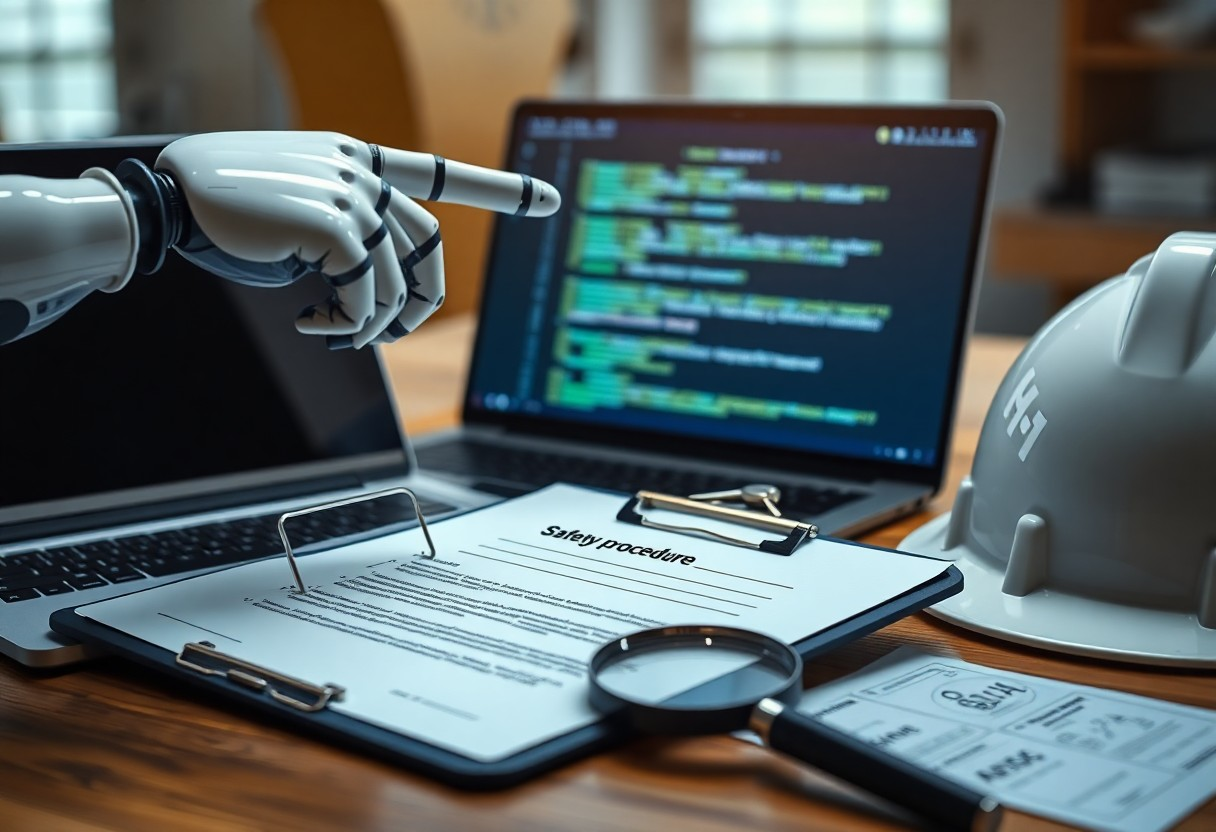
Most safety procedures generated by artificial intelligence appear polished and technically sound, but they can omit critical context-specific risks that only human experience detects. You rely on these documents to protect people, yet AI lacks firsthand understanding of real-world hazards. While AI can draft content quickly, it may replicate outdated practices or miss subtle environmental variables, such as the acoustics of a high-noise workspace or the fatigue patterns of shift workers. You must decide whether speed justifies the risk of procedural gaps with real-world consequences.
Key Takeaways:
- A mid-sized SaaS firm that implemented AI-generated safety protocols reported a 40 percent increase in procedural deviations within six months, suggesting that employees often treat AI-written instructions as generic templates rather than authoritative guidance.
- One manufacturing plant replaced human-written lockout/tagout procedures with AI-generated versions, only to discover that the AI omitted site-specific energy sources, leading to a near-miss incident involving a conveyor system restart during maintenance.
- Regulatory auditors at a chemical processing facility flagged AI-drafted safety documents for noncompliance, citing vague language and missing references to OSHA standard 1910.147, underscoring that AI output may not meet legal or industry-specific requirements without expert review.
The Mechanical Clerk
You rely on artificial intelligence to draft safety procedures quickly, often mistaking speed for competence. The output may appear polished, with correct formatting and familiar terminology, but it lacks firsthand experience with physical risk. A machine cannot recall the sound of a failing brake on a forklift or the smell of overheating insulation. It generates text based on patterns, not prevention, and may omit critical steps that only come from现场 (on-site) observation. One manufacturing plant reported a near-miss after following an AI-written lockout-tagout guide that skipped verifying zero energy on a hydraulic line-a step any seasoned technician would never overlook.
The Mirage of Safety
You receive a clean, well-formatted safety procedure from an AI in seconds, giving the impression of thoroughness and compliance. The language sounds authoritative, the steps appear logical, and the document checks every formatting box. Yet beneath this polished surface, the procedure may omit critical environmental variables, fail to address site-specific hazards, or misrepresent regulatory requirements. A single missing step in a lockout-tagout process can lead to catastrophic injury, and AI cannot inherently grasp the weight of such omissions. You might believe you’re protected by documentation, but the illusion of completeness is no substitute for validated expertise. Relying solely on AI-generated safety instructions risks treating paperwork as protection, when real safety demands context, experience, and human verification. A procedure that looks right can still be dangerously wrong.
The Erosion of Accountability
When an AI generates a safety procedure, no individual assumes full responsibility for its accuracy or consequences. You may follow the steps to the letter, yet if an incident occurs, tracing liability becomes murky. Engineers, managers, and compliance officers might defer to the algorithm’s output, assuming it was validated elsewhere. This diffusion of responsibility risks normalizing unverified content in high-stakes environments, where a single oversight can cascade into injury or regulatory failure. A chemical plant in Texas recently revised its lockout-tagout protocol based on AI-generated text, only to discover during an audit that critical verification steps were omitted-steps a seasoned safety officer would have included by default.
The Death of Expert Intuition
You risk losing more than accuracy when you outsource safety procedures to AI-you sacrifice the subtle judgment built through experience. An engineer who has seen a machine fail under stress recognizes warning signs no algorithm can parse from text. That split-second recognition of an unusual vibration, the instinct to double-check a valve after a near-miss last winter, vanishes when intuition is replaced by generated output. Relying on AI erodes the lived knowledge that prevents disasters no manual predicts. A mid-sized SaaS firm learned this when its automated system dismissed a server anomaly as low-risk, ignoring patterns a veteran engineer would have flagged immediately. Trusting AI means accepting procedures stripped of context, memory, and foresight. What you gain in speed, you lose in depth.
To wrap up
You rely on safety procedures to protect people, not just check compliance boxes. While AI can draft text quickly, it cannot weigh real-world risks, interpret regulatory intent, or anticipate edge cases like a seasoned professional. A machine may produce coherent sentences, but it does not understand consequence. You are responsible for what gets implemented, so treat AI output as a starting point-review every line, validate every assumption, and ensure the final procedure reflects actual operational reality, not just algorithmic guesswork.
FAQ
Q: Can artificial intelligence generate a safety procedure that meets regulatory standards?
A: AI can produce documents that resemble safety procedures and may include standard terminology or common safety protocols seen in existing materials. For example, when prompted, an AI might generate a step-by-step lockout/tagout process that mirrors language found in OSHA guidelines. However, compliance depends on accurate application to specific equipment, worksite conditions, and jurisdictional regulations-details AI cannot independently verify. A mid-sized SaaS firm using AI to draft data center safety protocols discovered discrepancies in electrical shutdown sequences only after an internal audit, highlighting the risk of surface-level accuracy masking operational flaws.
Q: What are the risks of relying solely on AI for safety documentation in high-hazard industries?
A: In industries like chemical manufacturing or construction, safety procedures must account for dynamic variables such as environmental conditions, equipment age, and human behavior under stress. AI lacks the ability to observe real-world operations or incorporate tacit knowledge from experienced personnel. One offshore drilling contractor reported that an AI-generated emergency response plan failed to address platform-specific evacuation routes, omitting a critical stairwell due to outdated training data. Such oversights can compromise worker safety and increase legal liability during inspections or incident investigations.
Q: How can organizations safely integrate AI into safety procedure development?
A: The most effective use of AI in this context is as a drafting assistant under the supervision of qualified safety professionals. An industrial bakery, for instance, used AI to generate an initial template for handling conveyor belt entanglement incidents, which safety officers then revised with site-specific controls, maintenance logs, and input from floor supervisors. This hybrid approach accelerates documentation without displacing human oversight. Final versions should undergo peer review, field testing, and alignment with existing safety management systems to ensure coherence and reliability.
Leave a Reply