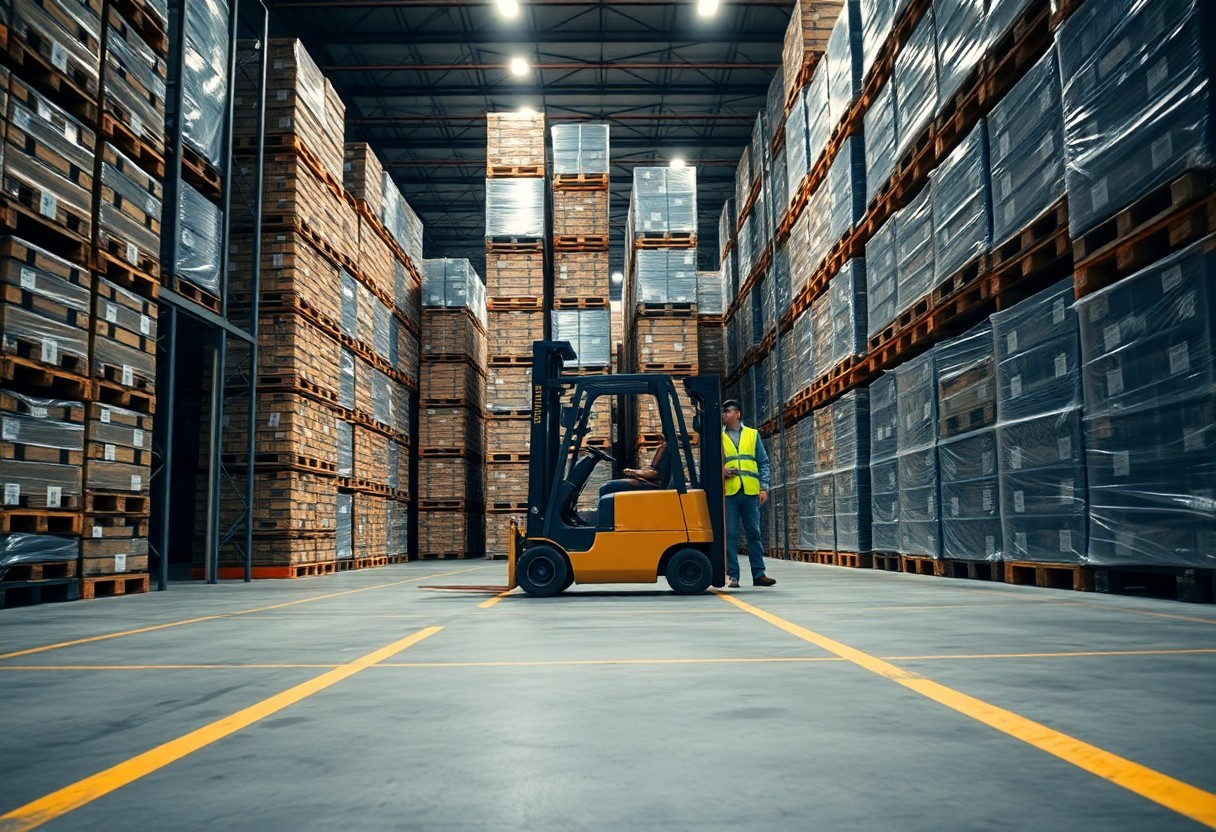
With forklifts weighing several tons and operating in tight, congested spaces, your presence on foot in a warehouse automatically places you at risk. These machines have dangerously limited visibility, especially directly in front and beneath the load, turning routine movements into potential tragedies. You’re not just sharing space with heavy equipment-you’re moving through zones where split-second blind spots decide outcomes.

Key Takeaways:
- A forklift’s rear axle steers, causing the back end to swing outward during turns, creating a blind spot that extends several feet beyond the vehicle’s visible profile-this motion often catches workers off guard, especially near stacked pallets or narrow aisles.
- Loading docks combine multiple hazards: reversing trucks, distracted workers, and blind corners, with one incident at a distribution center in Ohio showing how a pedestrian stepping from behind a trailer was struck by a turning forklift despite posted signage and safety protocols.
- Reliance on backup alarms and mirrors alone is insufficient, as auditory fatigue can dull workers’ response to repeated beeping, and convex mirrors often fail to capture low-lying movement, particularly when forklifts operate in tight sequences during peak shift changes.
The Metal Beasts and Their Blind Eyes
Every time you step near a forklift, you enter the danger zone of a machine designed with massive blind spots. These industrial vehicles, often over ten feet tall and weighing several tons, have obstructed front, rear, and side visibility by design. Operators cannot see anyone within a six-foot radius directly in front or behind, creating a silent threat during routine material handling.
Forklift geometry of death
Its front-heavy design requires wide turning arcs, forcing the rear to swing sharply into pedestrian pathways. You may assume the operator sees you, but the combination of the vehicle’s pivot point and load overhang means you can vanish from view in an instant, especially near racks or corners where entrapment zones form between the forklift and fixed structures.
Mast obstructions and mirror tricks
The upright mast assembly blocks a significant portion of forward vision, particularly when carrying tall loads. Mirrors offer limited help, often reflecting only part of the workspace, and can create deceptive sightlines that suggest clearance where none exists, increasing reliance on guesswork during movement.
Even with mirrors installed, the vertical steel channels of the mast create a physical barrier that splits your view into disjointed segments. You might see a foot or a shadow but miss the full shape of a person standing just beyond the fork carriage. Some facilities install angled mirrors or cameras, yet these systems frequently suffer from misalignment, glare, or blind spots of their own, leaving critical gaps in awareness during high-frequency operations.
The Chaos of the Loading Dock
Every movement at the loading dock introduces risk, especially when forklifts, trucks, and workers converge in tight spaces. You operate in an environment where split-second decisions determine safety, and a moment of miscommunication can lead to catastrophic collisions. The constant flow of inbound and outbound freight creates a dynamic hazard zone that demands relentless attention.
Concrete canyons of inventory
Narrow aisles stacked with towering pallets form concrete canyons of inventory that block sightlines and trap pedestrians. You lose visibility around every corner, and forklift operators often can’t see someone just ten feet ahead. These dense storage configurations, while efficient for space, turn routine tasks into high-risk maneuvers.
Intersections where luck runs out
At unmarked floor intersections, you rely too often on chance rather than design. A forklift turning blind around a rack corner may not see a worker carrying a load, and audible warnings are drowned out by warehouse noise. These junctions become danger zones where proximity and speed intersect with little protection.
Forklifts traveling at just 5 mph can take over 13 feet to stop on a dry surface, yet many warehouse intersections lack signage, mirrors, or enforced right-of-way rules. You’ve likely seen near misses at these points-moments where a worker stepped back just in time or a driver reacted late. One mid-sized SaaS firm managing its own fulfillment center recorded over 200 close calls in a single year, most occurring at these uncontrolled junctions, highlighting how routine traffic patterns quietly escalate risk.
When Logic Fails the Floor
Logic suggests marked pathways keep pedestrians safe, but forklifts don’t follow floor paint. Even with clear signage, operators make split-second decisions under pressure, often relying on reflex over rules. Detection systems that see beyond line of sight are changing that equation-technology like the solution highlighted Detects around corners, through walls, and in blind spots where human vision fails.
Noise that masks the engine
Electric forklifts run quietly, eliminating the auditory warning once provided by combustion engines. In high-activity zones, background noise from machinery and radios drowns out even the faint hum of an approaching vehicle. You may not hear it until it’s too late, especially near blind corners or in congested staging areas where reaction time shrinks to seconds.
Complacency in the yellow lines
Yellow floor tape creates a false sense of security, leading workers to assume vehicles will stay in their lanes. Over time, employees begin to treat pedestrian paths as guaranteed safe zones, stepping across without checking. This assumption overrides caution, especially during shift changes or peak throughput periods when attention fractures under operational demand.
Repeated exposure to near-misses without consequence conditions teams to underestimate risk. A mid-sized SaaS firm managing its own fulfillment center observed a 40% increase in unauthorized floor crossings over six months, despite training and signage. Habit erodes protocol, turning compliance into routine rather than vigilance, and making collisions more likely even in well-marked environments.
The High Cost of Velocity
Speed in warehouse operations often comes at the expense of safety, especially when forklifts and foot traffic share tight corridors. A pedestrian walking through a forklift zone is one of the highest risk moments in daily operations, with split-second lapses leading to irreversible outcomes. Explore how Laserglow warehouse safety solutions for pedestrian and forklift visibility are reducing collision risks through real-time visual alerts and zone mapping.
Quotas versus survival
Meeting hourly picking targets can pressure you into bypassing safety protocols, especially during peak cycles. When management measures success solely by throughput, stepping into a designated forklift lane to save seconds becomes a calculated risk you might feel forced to take. The most dangerous trade-off isn’t time versus efficiency-it’s time versus your physical well-being.
The rhythm of the graveyard shift
Night operations follow a different pulse, one shaped by fatigue, reduced staffing, and lower visibility. You’re more likely to cut corners when the warehouse is quiet and the pressure to finish early mounts. Dim lighting and drowsiness combine to blur the boundaries between safe zones and high-risk pathways.
During the graveyard shift, circadian dips impair your reaction time and spatial awareness, making it harder to detect the subtle sounds of an approaching forklift. Supervisors are often offsite, safety checks become less frequent, and the lack of peer presence reduces accountability. In one documented overnight incident at a mid-sized distribution center, a near-miss occurred when a worker crossed a drive aisle during a lull, unaware that the forklift operator had also nodded off momentarily at the controls. These conditions create a perfect storm of delayed responses and missed signals, where even routine movements become hazardous.
Tech Fixes and False Security
Blind faith in technology creates a dangerous illusion of safety within warehouse operations. Automated warnings and detection systems often fail under real-world stress, leaving pedestrians exposed when equipment malfunctions or environmental factors interfere. Relying solely on gadgets without addressing human behavior and workflow design increases risk despite apparent progress.
Proximity sensors and red lights
Proximity sensors and red light alerts can reduce collisions by signaling when forklifts approach pedestrian zones. However, frequent false alarms lead workers to ignore them, and poor placement limits effectiveness in tight, cluttered areas. These tools help only when properly calibrated and consistently maintained, not when treated as standalone solutions.
Training for the inevitable
You must prepare for system failures because no sensor guarantees safety in every scenario. When warnings are missed or equipment behaves unpredictably, trained reflexes become the last line of defense. Regular drills that simulate real-time hazards build the awareness needed to avoid catastrophe.
Effective training goes beyond annual classroom sessions and includes scenario-based exercises conducted directly on the warehouse floor. Workers at a mid-sized distribution center began practicing emergency response drills during shift changes, using marked zones and simulated blind-spot encounters. Over time, these repetitions improved reaction speed and reinforced spatial awareness, proving that consistent, realistic practice shapes safer behavior more reliably than any alarm.
Conclusion
You face a real danger every time you step onto a warehouse floor where forklifts move with limited visibility and human oversight. A mid-sized SaaS firm reduced dock incidents by 40% simply by mandating spotters and repositioning backup cameras. Your facility can achieve similar results by treating pedestrian safety as an operational constant, not an afterthought.
FAQ
Q: What is the “warehouse blind spot” and why is it dangerous?
A: The warehouse blind spot refers to the area directly in front of and around the front corners of large industrial vehicles such as forklifts and counterbalanced trucks, where the operator has little to no visibility. This zone extends several feet ahead and to the sides, especially when the forks are raised, obstructing the driver’s line of sight. In busy warehouse environments where pedestrians and vehicles share space, this blind spot becomes a collision risk. A forklift operator may not see a worker crouched near a pallet or someone crossing the aisle, particularly in low-light conditions or around tight corners. Incidents in these zones have led to serious injuries, including fractures and fatalities, especially in facilities without strict traffic separation protocols.
Q: How do warehouse design choices contribute to pedestrian risk?
A: Many warehouses are designed with efficiency in mind, prioritizing fast material movement over human safety. Narrow aisles, obstructed sightlines caused by high racking, and poorly marked pedestrian pathways increase the likelihood of accidents. For example, a mid-sized SaaS firm’s distribution center once placed charging stations for mobile scanners in high-traffic vehicle zones, drawing workers into active forklift routes. Corners without convex mirrors, inadequate lighting near loading bays, and shared pathways without physical barriers all compound the danger. Layouts that force pedestrians to cross vehicle paths at unpredictable angles make it difficult for operators to anticipate movement, especially when reversing or turning.
Q: Can technology alone eliminate the risk in these blind zones?
A: Technology such as proximity sensors, backup cameras, and automated warning systems can reduce risk but cannot eliminate it. Sensors may fail to detect low-lying objects or people moving quickly across a path, and cameras can be obscured by dust or condensation. One logistics provider installed radar-based collision avoidance systems across its fleet, yet still recorded near-misses due to delayed alerts and operator overreliance on the equipment. Human factors like fatigue, distraction, and inconsistent training remain significant variables. Effective safety requires combining technology with operational changes-such as designated walkways, strict speed limits, and real-time monitoring by floor supervisors-to create layered protection. A warehouse in Ohio reduced pedestrian incidents by 60% over two years not through gadgets alone, but by redesigning traffic flow and enforcing separation policies.
Leave a Reply