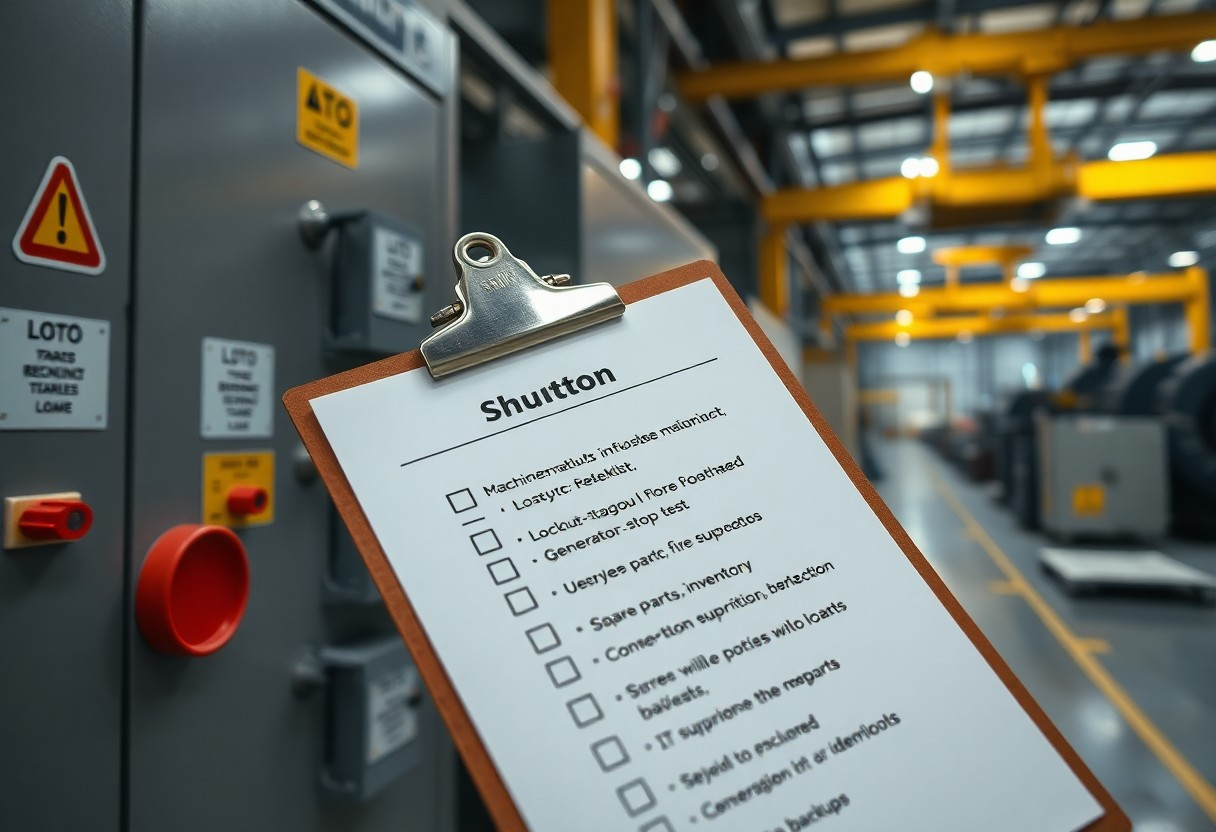
There’s a narrow window between production halts and costly delays, and overlooking a single lockout point can trigger days of downtime. As a Hamilton manufacturer, your next shutdown demands precision, not guesswork. Unexpected equipment failures during restarts have derailed operations at steel fabricators on Barton Street, proving that preparation separates resilience from risk. You must verify systems methodically-every time.
Key Takeaways:
- A documented mechanical integrity checklist, reviewed quarterly, prevents unexpected equipment failure during restart-Hamilton’s industrial pumps at a polymer processing plant failed in 2022 due to unchecked bearing wear that routine vibration analysis could have flagged.
- On-site availability of mission-critical spare parts, such as valve actuators and motor control relays, reduces mean time to repair; one automotive component manufacturer cut downtime by 40% after mapping failure modes to a localized inventory system.
- Lockout/tagout procedures must be verified at the device level before any shutdown, as a 2023 incident at a steel fabrication facility showed that improperly isolated hydraulic systems can energize unexpectedly during maintenance.
The Iron Pulse: Mechanical Integrity
Every machine in your facility has a rhythm, a mechanical heartbeat that falters without consistent oversight. Undetected wear in drive systems can trigger cascading failures, halting production faster than a tripped breaker. Preventive scrutiny isn’t optional-it’s the baseline for operational continuity when restart pressure mounts.
Inspecting the Main Drive
A cracked flywheel or misaligned coupling can destabilize entire production lines. Check for unusual vibration patterns and audible grinding during low-speed operation, as these often precede catastrophic breakdowns. A 15-minute inspection now prevents days of downtime later.
Lubrication of the Joints
Dry or contaminated joints increase friction, accelerating wear on connected components. Ensure all pivot points receive manufacturer-specified lubricants before every shift, especially on high-cycle robotic arms and press linkages common in metal stamping operations.
Lubrication isn’t a one-size-fits-all task-grease type, quantity, and frequency must match each joint’s load and motion profile. Over-greasing can rupture seals, introducing debris, while under-greasing leads to metal-on-metal contact. A mid-sized SaaS firm managing maintenance logs found 30% of joint failures followed incorrect lubrication intervals, not age or usage.
The Inventory of Necessity: Spare Parts
Every shutdown reveals which components stand between uptime and costly delays. You know the machines that fail most often. Stocking their spare parts prevents extended downtime, especially for legacy systems where replacements take longer to source. A well-maintained inventory reflects hard-won operational experience.
Auditing the Critical Stock
Start by identifying parts that halt production when unavailable. Focus on long-lead-time items and those with a history of failure. A mid-sized SaaS firm might track server modules, but here, it’s gearbox seals or motor couplings. Missing one key component can idle an entire line.
Ordering for the Return
Place orders before the shutdown begins, not after. Suppliers face surges in demand during restart periods. Delayed shipments are the most common bottleneck during resumption. Lock in delivery dates in advance to align with your restart timeline.
Anticipate not just what broke last time, but what stress from resumed operations might break next. High-cycle systems often fail within the first 72 hours of restart. Order wear-prone parts like gaskets, bearings, and drive belts early, and confirm supplier readiness. A pre-shutdown purchase order with confirmed lead times is more valuable than any post-failure rush.
The Silent Grid: Energy Isolation
Energy isolation prevents catastrophic startup during maintenance, a leading cause of industrial injury. You must verify every machine’s lockout/tagout procedure is documented, up to date, and followed without exception. Failure to isolate all power sources risks severe harm and regulatory penalties.
Locking the Power Sources
Each machine’s primary and backup power connections require individual lockout devices. You should confirm every authorized worker applies their own lock and verifies zero energy state before beginning work. A single unsecured circuit can lead to life-threatening incidents.
Draining the Lines
Residual pressure in hydraulic or pneumatic systems can release with deadly force. You must ensure all lines are bled, valves secured, and pressure gauges read zero. Neglecting this step risks unexpected equipment motion and serious injury.
Even after shutdown, stored energy in springs, capacitors, or elevated components remains a hidden threat. You need to follow manufacturer-specific procedures for each system, especially in automated assembly lines where multiple energy types intersect. A mid-sized SaaS firm managing industrial IoT sensors reported repeated alerts from unvented hydraulic accumulators-proof that overlooked energy release points persist without rigorous checks.
The Safety of the Shop: Hazard Control
Ensure all hazard controls are fully operational before restarting operations, especially after a federal funding disruption such as the recent shutdown (see Congress Ends Shutdown: What the New Funding Law …). Chemical storage areas must be sealed, ventilation systems verified, and warning signage clearly posted to protect personnel from exposure.
Clearing the Walkways
Obstructed pathways increase slip, trip, and fall risks during high-activity restart phases. Remove debris, tools, and temporary equipment from aisles and emergency exits. Keep all egress routes unblocked to ensure rapid evacuation if needed, particularly in low-visibility scenarios.
Checking the Fire Suppression
Fire suppression systems often degrade during idle periods due to temperature shifts or tampering. Inspect sprinkler heads, alarm triggers, and suppression cylinders for damage or corrosion. A single compromised nozzle can disable an entire zone in a facility the size of a Hamilton automotive plant.
Monthly visual checks are insufficient after prolonged shutdowns. Engage certified technicians to test dry-pipe system integrity and confirm that suppression agents like FM-200 or clean agents remain at required charge levels. Delays in activation can allow fires to breach containment walls within three minutes, endangering both personnel and structural stability.
The Human Element: Staff Readiness
People remain the most unpredictable yet imperative component in any shutdown. You must verify that every team member understands their role, has current certifications, and can respond to emergencies without hesitation. A misstep by one individual can cascade into hours of delay or a safety incident.
Reviewing the Shift Schedule
Shift handovers often create gaps in accountability. You should confirm that overlap periods are clearly defined and staffed, especially for critical monitoring tasks. A mid-sized SaaS firm managing plant-floor software learned this when an unlogged system drift occurred during a blind shift transition.
Confirming the Safety Brief
Every technician must attend a documented safety briefing before entry. You are responsible for ensuring attendance logs are complete and that all hazards, including confined spaces and lockout zones, are verbally reviewed and acknowledged.
Safety briefs are not a formality but a final cognitive checkpoint. You should require supervisors to walk through real-time scenarios, such as a sudden pressure release in a valve manifold, ensuring each worker can articulate their response. A Hamilton plant avoided a potential arc flash injury because a technician recalled a specific warning from that morning’s briefing.
The Final Sweep: Industrial Hygiene
Before powering down, conduct a thorough industrial hygiene sweep to eliminate health hazards that could compromise air quality or worker safety upon restart. Residual dust, chemical residues, or microbial growth in ducts and surfaces can trigger regulatory violations or respiratory issues. For guidance on compliance during shutdowns, review Shutdown Redux from industry legal experts.
Removing the Waste
Dispose of all hazardous and non-hazardous waste according to provincial regulations, ensuring containers are properly labeled and sealed. Leftover solvents, metal shavings, and used filters can pose fire or contamination risks if left onsite during idle periods, especially in confined spaces near ventilation intakes.
Sealing the Storage
Securely cap and seal all chemical storage containers, even those remaining in ventilated cabinets or outdoor lockers. Unsealed drums can emit toxic vapors over time, particularly in temperature-fluctuating environments, risking both indoor air quality and compliance during unattended periods.
Hamilton’s humid climate increases the risk of off-gassing and container corrosion during prolonged shutdowns. Use secondary containment trays with intact seals and verify that storage room exhaust systems are operational before lockup. A mid-sized SaaS firm managing industrial facilities reported repeated vapor alarms traced to improperly sealed acetone containers stored near HVAC returns.
Summing up
You verify lockout-tagout procedures are fully documented and consistently applied across all production lines. You confirm every technician has completed refresher training on emergency shutdown protocols within the last quarter. You ensure spare parts for critical machinery are physically on-site and cataloged. You test backup power systems under load at least once monthly. A mid-sized SaaS firm might prioritize server uptime, but in Hamilton’s manufacturing plants, operational continuity depends on these tangible, repeatable checks completed well before the next unplanned stoppage.
FAQ
Q: What mechanical systems should Hamilton manufacturers prioritize when preparing for a potential shutdown?
A: Manufacturers in Hamilton should focus on inspecting high-stress mechanical systems such as gearboxes, conveyor drives, and hydraulic units, especially in facilities processing steel or fabricated metals. These components often show early signs of wear under continuous operation and can fail during restart if not assessed beforehand. A mid-sized metal stamping plant on Barton Street recently avoided unplanned downtime by identifying a misaligned drive shaft during a pre-shutdown check, allowing for realignment before operations resumed. Bearings, couplings, and tensioning mechanisms also require vibration analysis and lubrication verification to prevent cascading failures.
Q: How can a facility ensure energy isolation procedures are effective before a shutdown?
A: Effective energy isolation starts with verifying that lockout/tagout (LOTO) procedures are up to date and reflect current equipment configurations. Each energy source-electrical, pneumatic, hydraulic, and gravitational-must be individually isolated and tested for zero energy state. A plastics injection molding facility on Mohawk Road discovered during a pre-shutdown audit that outdated LOTO tags were still in use for two auxiliary chillers, creating a serious safety gap. Workers now conduct live drills before every scheduled shutdown, simulating isolation sequences to confirm valve positions, circuit breaker status, and bleed-down times for pressurized lines.
Q: Why is spare parts inventory verification critical before a shutdown, and what parts are most commonly overlooked?
A: Unexpected equipment failures during restart often hinge on the availability of specific replacement components, making pre-shutdown inventory checks necessary. Commonly overlooked items include fuses with non-standard ratings, programmable logic controller (PLC) communication modules, and custom-sized O-rings used in older machinery. One Hamilton-based food processing line experienced a 36-hour delay after a motor controller failed, only to find the replacement module was discontinued and no backup was stocked. Facilities now maintain a categorized spare parts list, cross-referenced with equipment manuals and supplier lead times, to reduce exposure to obsolescence and supply chain delays.
Leave a Reply