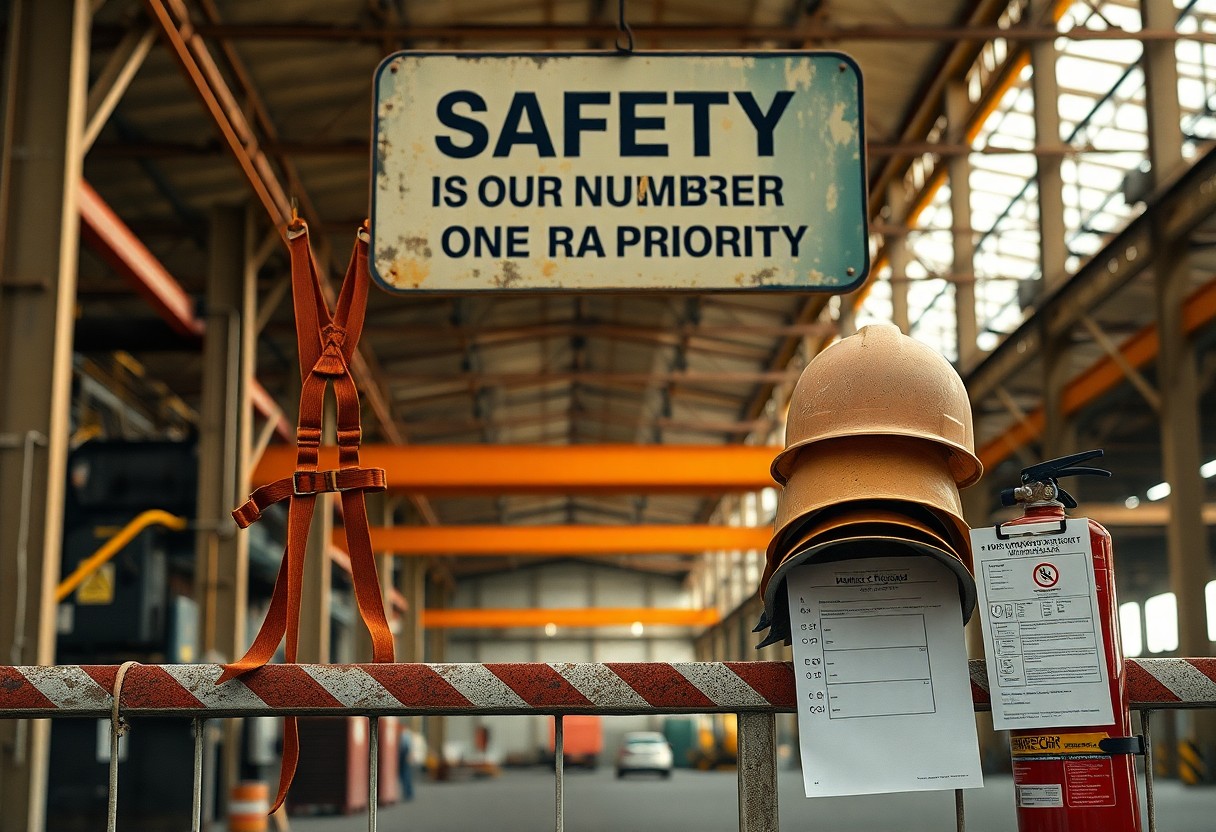
Over a decade of incident reports and worker interviews reveals a persistent gap between safety slogans and daily experience. You hear “safety is our number one priority” at morning meetings, yet continue to work under deadlines that pressure cutting corners. A mid-sized SaaS firm may tout zero incidents, while maintenance crews on the factory floor report unfixed hazards and retaliation for speaking up. You know the truth when procedures are bypassed to meet output targets.
Key Takeaways:
- A mid-sized SaaS firm reduced incident reports by half after replacing top-down safety memos with weekly worker-led safety reviews, showing that trust in frontline judgment matters more than slogan repetition.
- When a manufacturing plant in Ohio tied supervisor bonuses solely to output metrics while verbally emphasizing safety, injury rates rose 30% over 18 months, exposing the contradiction between stated values and operational incentives.
- Workers at a logistics warehouse began bypassing lockout-tagout procedures after noticing that safety violations were rarely addressed unless they caused downtime, proving that inconsistent enforcement erodes message credibility.
The Litany of Empty Phrases
Leaders repeat “safety first” so often that it becomes background noise, not guidance. You hear it during morning briefings, see it on posters above break rooms, yet feel no connection to its meaning. When actions don’t align with words, the phrase loses weight, collapsing under the weight of unmet expectations. A single incident with no follow-up proves louder than a thousand slogans.
Slogans as a form of corporate prayer
Ritual repetition of “zero harm” mimics incantation, spoken with faith but no mechanism for fulfillment. You recite it in meetings, sign off on it, move on-yet no one adjusts the schedule when fatigue sets in. Like prayer without action, it asks for protection while ignoring the conditions that create risk. The mantra persists, even as its power to influence behavior fades.
The decay of meaning in the workplace
Terms like “we care” erode when used without visible proof. You notice the gap when maintenance delays pile up or when PPE arrives a month late. Each unaddressed near-miss chips away at trust. Language meant to reassure begins to signal indifference instead, especially when leadership uses it to close meetings but not to change decisions.
Consider a mid-sized SaaS firm that plastered “well-being matters” across its internal portal while requiring weekend deployments without notice. Engineers began referring to the slogan as a joke during post-mortems, a signal that the phrase no longer held value. When leadership finally paused to ask why engagement scores dropped, they discovered the problem wasn’t morale-it was the growing disbelief in every word spoken from above.
The Tyranny of the Unspoken Quota
Production targets shape behavior more than posted slogans ever can. When daily output expectations are communicated through silence rather than policy, workers learn quickly that speed trumps caution. A supervisor’s glance at the clock during a safety check speaks louder than any poster in the break room. This hidden pressure erodes trust in stated values.
Where safety meets the stopwatch
Time studies and cycle times often dictate workflow, not hazard assessments. If your task is measured to the second and a near-miss report takes ten minutes to file, the math pushes you to keep moving. A technician at a Midwest packaging plant once bypassed a lockout because stopping would have delayed the line by 47 seconds-costing the team their daily bonus.
The punishment for following the rules
Stopping work for a hazard can mean missing a shift target, drawing a reprimand, or being labeled “not a team player.” One electrician in an Alberta mine was sidelined from overtime for three weeks after halting a drill move due to unstable ground-despite a site safety officer later confirming the risk. Compliance became a career liability.
Management rarely issues formal discipline for adhering to safety protocols, but informal penalties are common. You might find yourself excluded from high-visibility assignments, passed over for promotions, or subtly isolated in team settings. At a Gulf Coast refinery, a crew member who consistently enforced permit requirements was reassigned to night shifts without explanation-coinciding with the start of a major turnaround where speed was emphasized. Doing the right thing quietly became a barrier to advancement.
The Reality of the Grimy Surface
Walking onto the worksite, you see it immediately-the oil-stained concrete, the frayed cable coiled near the generator, the guard missing from the conveyor. These are not isolated oversights but signs of a system where safety rhetoric collapses under operational pressure. A report by Getting Home Safely – WorkSafe ACT underscores how visible neglect erodes trust in verbal assurances.
Discrepancies between office and floor
Managers in clean uniforms talk of zero harm while you’re handed worn gloves with cracked seams. The gap between policy documents and the tools you’re given tells you what the company truly values. When safety investments stop at PowerPoint slides, your experience becomes the real audit.
The worker’s instinct for the truth
You don’t need a risk register to know when something feels wrong-the wobble in the scaffold, the supervisor’s rushed tone, the skipped checklist. That gut reaction is honed by repetition, near misses, and unspoken lessons from older hands. It’s not paranoia. It’s survival.
That instinct sharpens every time a hazard is downplayed or a concern met with silence. You notice who steps back when the crane swings the load and who keeps working without looking up. These behaviors, repeated over weeks and shifts, form a parallel safety system-one built on observation, not slogans. When leadership ignores these cues, the message is clear: compliance matters more than care.
The Bureaucracy of Simulated Care
What you experience daily isn’t oversight-it’s theater. Managers demand incident reports not to prevent harm but to build files, creating the appearance of control. The real goal often isn’t your safety, but the company’s defensibility in court. Every form you sign becomes evidence in a case that hasn’t happened yet, with your compliance serving legal insulation, not protection.
Form-filling as a substitute for action
Completing a risk assessment after a near-miss feels like doing something, but often nothing changes on the ground. You’ve seen it: a hazard reported, a form filed, and the same danger remains. The act of documenting becomes the resolution, with paperwork mistaken for progress, leaving you exposed just as before.
Protecting the firm instead of the man
Safety protocols are frequently designed to shield the organization, not the worker. When investigations focus on who signed what, rather than why a machine lacked a guard, the priority is clear. Legal exposure matters more than physical risk, and you’re expected to accept that distinction without question.
Consider a mid-sized SaaS firm that mandated daily safety checklists for warehouse staff, yet delayed repairs on a known forklift fault for three months. Internal emails revealed concerns about liability if an accident occurred without documentation, but no urgency about the faulty equipment itself. The checklist gave the illusion of vigilance while the actual threat grew. Procedures were followed to the letter, just not to the purpose.
The Recovery of Honest Communication
Rebuilding trust starts when leaders stop reciting slogans and begin speaking with clarity and candor. Workers recognize sincerity when it arrives without corporate filters, especially after years of polished statements that ring hollow. What matters most is not what you say, but what you do consistently under pressure. A single unscripted moment of accountability often carries more weight than a hundred posters declaring safety first.
Deleting the jargon from the manual
Complex terminology in safety manuals often obscures more than it clarifies. When procedures are written in dense, legalistic language, workers must interpret intent instead of following clear instructions. Replacing phrases like “incident mitigation protocol” with “how to stop a fall” makes actions immediate and understandable. Clarity becomes a form of respect.
Proof of priority through sacrifice
You prove safety matters not by stating it, but by what you’re willing to give up for it. Halting a production line for a minor hazard, delaying a shipment to fix a guardrail, or publicly supporting a worker who stops work-these acts signal real commitment. Silence after a near-miss speaks louder than any slogan.
Sacrifice gains meaning when it’s visible and consistent. A mid-sized SaaS firm once paused a product launch to retrain on server safety after a minor electrical fault, even though the issue didn’t halt operations. The decision wasn’t required by regulation, but it was remembered by the team for years. Such choices transform abstract values into lived experience.
Final Words
You know the phrase sounds hollow because it’s repeated without alignment to daily decisions, like when production deadlines override hazard reports or when safety meetings are scheduled after incidents, not before. Workers notice when budgets cut corners on protective equipment while funding overtime bonuses. Your skepticism isn’t defiance-it’s observation, shaped by the gap between what’s said in briefings and what’s enforced on the floor, such as a supervisor rushing a repair without lockout-tagout. Trust erodes not from one lie, but from a pattern of actions that say safety is merely a slogan, not a standard.
FAQ
Q: Why do workers often distrust the phrase “safety is our number one priority”?
A: Workers hear the phrase repeatedly in safety briefings, posters, and management speeches, yet observe decisions that prioritize output over protection. A mid-sized SaaS firm may highlight safety in its core values while pressuring teams to deploy code under tight deadlines, bypassing full testing protocols. When leadership celebrates on-time delivery despite skipped safety checks, employees register the contradiction. Trust erodes not because they expect perfection, but because the gap between stated values and visible actions widens over time. A warehouse operator, for instance, might be reprimanded for stopping a conveyor belt during a near-miss, sending a clear message about what the company truly prioritizes in moments of tension.
Q: Can safety ever be the top priority if production targets exist?
A: The conflict arises not from having both safety and production goals, but from how trade-offs are managed. In a chemical processing plant, operators once reported pressure to maintain throughput despite a recurring alarm on a pressure valve. Maintenance was delayed for two weeks to avoid interrupting a high-volume production cycle. The incident was logged internally but not escalated. When the valve failed months later, causing a non-injury release, the investigation revealed that safety systems were functional but routinely overridden. The presence of dual goals isn’t the issue-what matters is whether safety has veto power when risks emerge. Without structural mechanisms to halt operations without penalty, the claim of top priority remains rhetorical.
Q: What concrete changes would make safety messaging more credible?
A: Credibility comes from consistency in resource allocation, recognition, and accountability. A construction crew on a hospital project began tracking not only incident rates but also the number of work stoppages initiated by frontline workers and how quickly management responded. Over six months, the crew recorded 14 stop-work actions, all met with on-site supervisor follow-up within two hours. These interventions were acknowledged in team meetings, and no worker faced indirect retaliation such as reassignment or exclusion from overtime. The shift did not eliminate hazards, but it altered perceptions. Workers cited the visible response pattern-not slogans or training hours-as the reason they began reporting more near-misses. Recognition of proactive behavior, paired with protected channels for intervention, built a more tangible sense of commitment than any slogan could convey.